Importance of Co-Curricular Activities for Students
Dipankar Sarkar

“All work and no play makes Jack a dull boy.”
In many schools' classrooms, corridors, activity rooms, and playgrounds, it is not uncommon to hear questions like “Why am I doing this activity?” and “What is the importance of co-curricular activities?”. You might have also asked these questions or thought about them. Your parents might have asked these questions. Moreover, even your teachers might have similar queries.
What is Co-Curricular Activities
Co-Curricular activities meaning? Co-curricular activities are those activities that are undertaken along with academic studies. Typically, co-curricular activities are carried out outside the normal classrooms, but they supplement the academic curriculum and help in learning by doing. These activities help students to develop problem-solving, reasoning, critical thinking, creative thinking, communication, and collaborative abilities.
Co-curricular activities in school might be compulsory such as music, art, or drama classes that take place during the day. Others could be voluntary, such as participating in a school sports team, school debating teams, or student newsletters editorial team. In either case, participation helps students in emotional development, social skill development, and overall personality development. Therefore, the importance of co-curricular activities is immense.
Importance of Co-Curricular Activities
In the 21st Century, the world is changing fast. Therefore, the conventional education curriculum, which was developed in the early 20th Century, has to pave the way for a new kind of education and learning. In the book 21st Century Skills: Learning for Life in Our Times, the authors Bernie Trilling and Charles Fadel have premised that “the world has changed so fundamentally in the last few decades that the roles of learning and education in day-to-day living have also changed forever”.
Also, in the book Five Minds for The Future, the author Howard Gardner has outlined five specific mental abilities that will help one be successful and happy. The five mental abilities or Minds as written by Howard Gardner are – The Disciplinary Mind (expertise in various subjects), The Synthesizing Mind (ability to integrate concepts from different disciplines to solve a problem), The Creating Mind (ability to think creatively to solve problems), The Respectful Mind (appreciation of the diversity in individuals), and The Ethical Mind (fulfilling one’s duties and responsibilities in the society as a citizen).
These concepts emphasize that in the 21st Century, education and learning must surpass the four walls of a classroom. So, the core aim of education and learning should be to foster holistic development. However, the importance of co-curricular activities cannot be overlooked in fostering holistic development.
Holistic development essentially means intellectual, physical, emotional, and social development, which can be achieved only through proper education. Therefore, education plays a fundamental role in holistic development.
Co-curricular activities help develop students' holistic development and assist in developing critical skills and abilities to be successful and happy in 21st Century life and workplaces. Therefore, the importance of co-curricular activities is immense during school and college education.
12 Essential skills and values that you can develop through co-curricular activities
When theoretical curriculum and co-curricular activities are integrated, your chance of learning more and exploring your strengths, interests, and abilities becomes higher. Therein lies the importance of co-curricular activities, which are supplementary to the theoretical curriculum.
It is true that much of your intellectual development happens, to a great extent, in the classroom itself. But, various other aspects of your personality, such as emotional and social skill development, happen to a large extent through co-curricular activities. Therefore, holistic development cannot deny the key role and importance of co-curricular activities.
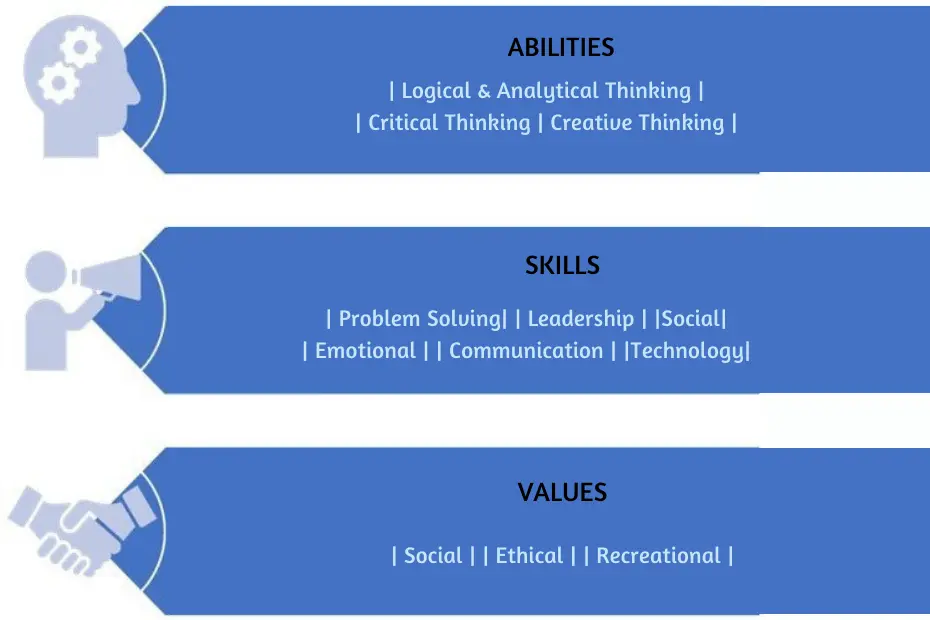
Essential skills and values that you can develop through co-curricular activities are:
Logical and analytical thinking – Analyzing reasons behind events and situations
Critical thinking – That is examining concepts, ideas as well as problems and issues
Creative thinking – In other words, thinking of newer ways to solve problems; visualization; thinking of new ideas
Problem-solving skills – For instance, solving problems utilizing various concepts, solutions, etc.
Leadership skills – For instance, taking initiatives and responsibilities; influencing others in working for a good purpose; setting goals; motivating others to work towards goals; taking accountability
Social skills – Includes collaboration; teamwork; building good relationships with others
Emotional skills – Understanding your strengths and weaknesses; controlling your emotions as well as empathy for others
Communication skill – Includes the power of expression, listening to others, public speaking etc.
Technology skills – Using various computer software and apps to get things done
Social values – In other words, respecting differences among individuals, respecting others' values and culture
Ethical values – For example, maintaining ethics in public life; good moral values etc.
Recreational values – Understanding the importance of leisure and recreation; participating in leisure and recreational activities.
Figure: Essential Abilities, Skills, and Values developed through co-curricular activities
50 Most Important Co-curricular Activities List
Moving forward, we will now list the 50 most important co-curricular activities for you. Here’s the list:
Sports – For instance, cricket, football, volleyball, badminton, basketball, table tennis, swimming, diving, hockey, skating, archery, rowing, kayaking, cycling, etc.
Indoor games – For instance, chess, carrom, scrabble, etc.
Physical exercise
Fitness training
Athletics
Boxing
Martial art – For instance, karate, jujutsu, taekwondo, etc.
Yoga
Meditation
Modeling – scientific modeling
Art and craft
Clay modeling
Sculpture making
Ikebana – flower arranging
Origami – creating art forms by folding papers
Vocal Music (classical)
Vocal Music (contemporary)
Instrumental Music – For instance, harmonium, tabla, sarod, tanpura, piano, guitar, drums, percussion, violin, cello, synthesizer, etc.
Folk songs
Classical Dance
Contemporary Dance
Folk dance
Drama and theatre – For instance, story writing, scriptwriting, acting, direction, production, etc.
Commercial art – advertising campaign; public relations campaign
Debate
Elocution contest
Creative writing – For example, poetry writing competitions, story writing competitions, etc.
Essay writing competition
Story writing competition
Poetry recital
Student newspaper writing, editing, and publishing
Wall magazine writing, editing, and publishing
Photography
Videography
Painting
Drawing and Painting competition
Tailoring
Carpentry
Toy-making
Soap making
Candle Making
Embroidery
Knitting
Gardening
Weaving
Celebration of cultural festivals
Organization of awareness programs – For example, personal hygiene awareness, cleanliness drives, AIDS awareness, tree planting drives, etc.
Celebration of days – For example, World Environment Day, Women’s Day
Participation and management of student clubs, societies, etc. – For instance, debating society, writers’ club, music club, book reading club, etc.
Camping and related activities – such as camping in the wilderness, nature walks, hiking, etc.
Connect with a counselor
New Age Co-Curricular Activities List For School
Computer Coding competition
Ethical Hacking competition
Computer Gaming competition
Online Magazine/ Newsletter Writing, Editing, and Publishing
Media Design – design of various media such as film, video, and web interfaces
Blog writing
Graphic Designing
Web Designing
Digital art
Career education – In other words, an exploration of different career options and educational pathways after school
Job shadowing – such as spending a day or more with a professional at work to understand the nature of work, responsibilities, etc.
A day at work – such as spending a day at a company or at a factory to see how commercial and industrial activities happen
Co-curricular activities in school and outdoor – list of athletics and sports

Aerobics
Archery
Athletics include sprinting, long-distance running, hurdles, high jump, long jump, shot put, discus throw, etc.
Badminton
Baseball
Basketball
Bicycle
Billiards
Boxing
Chess
Climbing (Rock climbing)
Cricket
Cycling
Diving
Equestrian
Fencing
Football
Gymnastics
Handball
Hockey
Judo
Kabaddi
Karate
Kho kho
Kayaking
Martial Art
Mountain Biking
Polo
Rowing
Rugby
Shooting
Snooker
Squash
Swimming
Table Tennis
Tennis
Volleyball
Water polo
Weight Lifting
Wrestling
Benefits of co-curricular activities
Co-curricular activities are vital because even though they are not a part of the core curriculum, they play a very crucial role in giving young boys and girls the ability to shape their lives. The school activities have to be designed purposefully to give an apt mix of students' participation in academics and also to create a chance for all-around development. The importance of co-curricular activities cannot be ignored.
To understand the importance of co-curricular activities, let us see how these activities benefit students:
Enhances overall personality
Co-curricular activities in school help to enhance the overall personality of the students. These prepare them to take challenges heads up and also enable them to think critically. Moreover, experiences and skills acquired through these co-curricular activities make students proactive and prepared for their future endeavors. Therefore, the importance of co-curricular activities cannot be denied in overall personality development.
Strengthen Self Confidence
The goal of co-curricular activities is to give students better fitness and inculcate a sense of sportsmanship, competitive spirit, leadership, meticulousness, cooperation and team spirit. Therefore, many institutions are appreciating the importance of co-curricular activities, integrating a number of co-curricular activities in their syllabus, and making it mandatory for the students to choose their interest in co-curricular activities from a list of options. So, the hidden motive behind all this is to develop self-confidence and trust in others.
Develop Specialised Skills
Co-curricular activities in school help hone the talents of young minds and give them an opportunity to develop their specialized skills. Competitions that are organized can also create a competitive environment and help them work towards continuous improvement in their skills.
Therefore, a number of schools are now understanding the importance of co-curricular activities right from the early stages of school so that students can benefit in the future as well.
Improve Academic Performance
Studies have shown that students pursuing their hobbies achieved better results in their studies. Likewise, their academic performance goes way up as they learn to balance their co-curricular activities with their academic pursuits. They also better understand how to manage their time efficiently and also increase their interest in school. Therefore, it is essential to understand the importance of co-curricular activities in improving academic performance.
Greater Opportunities
In this competitive era, records of participation in co-curricular activities can act as game changers during admissions into various courses. For instance, students pursuing any co-curricular activities of their choice are given preference over those who are not involved in any such activities. Therefore, the importance of co-curricular activities is immense in their future pursuits.
Exposure to New Activities
Students are introduced to a whole new horizon of activities that give them better insights and let them choose what they enjoy and wish to learn. In other words, it broadens new horizons for them. These activities stimulate students' playing, painting, acting, dancing, singing, speaking, and many other skills. Thus, co-curricular activities broaden the scope of students in learning and exploring new activities. Thus, the importance of co-curricular activities is a lot in this aspect.
Builds Sense of Responsibilities
When students in their early life are given some responsibility or a task to handle like an application of first aid or managing the class painting board, etc., their efficiency in handling such situations becomes much better. In other words, these activities foster a sense of responsibility and accountability.
Enhance Physical and Mental Health
Also, co-curricular activities require students to stay active at school by participating. As students have no option to skip these activities, such as athletics, gymnastics, yoga, indoor games, meditation, etc. because they are part of their curriculum. This makes the importance of co-curricular activities very high.
Co-curricular activities are helpful for students as they enhance their physical and mental health of a student and help relieve students from academic stress.
ACCESS OUR FREE CAREER DASHBOARD
Conclusion
Therefore, as students should be given more and more opportunities to explore their interests and abilities, the importance of co-curricular activities cannot be denied. In order to instil the ‘all-rounder’ factor in students, co-curricular activities in school are being integrated into the academic curriculum in schools across several countries in the world. Also, the importance of co-curricular activities in the integrative school curriculum is appreciated.
Moreover, the rewards of co-curricular activities in schools have been researched pretty well, and it is now ascertained that students who participate in these activities show better academic results, stronger relationships in schools and are more likely to lead a healthy and active lifestyle.
Furthermore, students also feel a sense of belonging to the school and have higher self-esteem by participating in structured activities like music, dance, performing arts, etc. In addition to this, students become more motivated to perform better in their academics. This also makes the students feel happier, healthier and involved. So this establishes the importance of co-curricular activities clearly.
For more details and for expert guidance on which co-curricular activities would fit your curriculum, you may take advice from the experts at iDreamCareer.
You can avail the services of iDreamCareer on the following fronts:
Also Read :
Connect with a Counselor

About the author
After acquiring a bachelor’s degree in Pharmaceutical Technology from Jadavpur University, Kolkata, and a post-graduate diploma in management, Dipankar has been working as an entrepreneurial leader as well as a career guidance expert. He has provided career guidance and assistance to higher education students for over two decades with noteworthy achievements